Categories
Blog Out in Healthcare

Out in Healthcare: Enrique Puentes, OTS

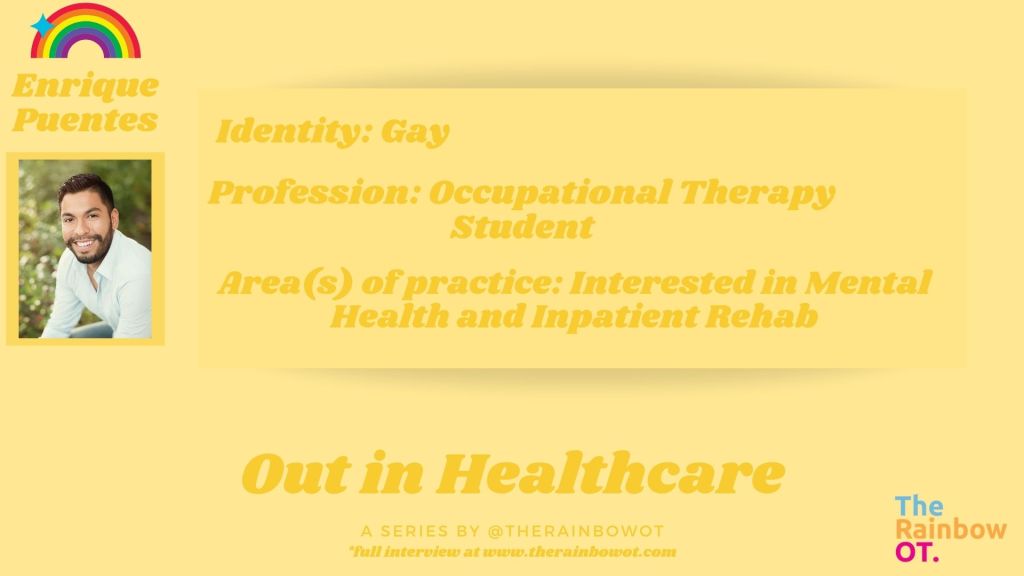
Name: Enrique Puentes

Pronouns: He/Him/His

Identity: Gay

Background: Both of my parents immigrated from Colombia, and I was born in Washington, D.C. I grew up in Northern Virginia but have spent the last fourteen years living in Central Florida. I have spent the past eight years working in catastrophe property insurance but have always had a longing for wanting to be in a profession that helped others improve. I finally decided to make the career transition and now am in my second term of my master’s degree.

Profession: Occupational Therapy Student (MOT)

Area(s) of Practice or Interest: I have huge interests in both Mental Health and Inpatient Rehabilitation but am unsure of where I may ultimately end up.
What does being ‘Out in Healthcare’ mean to you?: For me, being out in healthcare for me means inviting people to see my truest self. Representation of LGBT people in healthcare is important because not only does it create safe spaces for clients to feel they are being advocated for, but it also can help demystify misunderstandings that non-queer people have of the very community that I am a part of. I see being out in healthcare as a form of activism for anyone who has ever felt either marginalized in a society that has long celebrated heteronormativity.  

What is one thing everyone should know about your identity?: I want people to know that I am embracing the best possible version of myself by being out as an individual in healthcare. It is important for me to not be ‘discrete’ about my sexuality, because by me fully loving all aspects of my identity, I can in turn emanate the same level of love and care for others. 

How do you feel when your identity is included?: When my identity is included as both brown and gay, I feel included and seen as an equal amongst a group.

What does “taking up space” mean to you?: Taking up space means feeling pride about my own visibility and feeling the confidence in the fact that my visibility matters. I unfortunately did not always think/feel this way, so it’s empowering for me to live in this truth.

What is one piece of advice that you would give to healthcare workers who aren’t sure how to honor the identities of their patients?: I think with any profession that involves interacting with all kinds of people (with varying cultures, backgrounds, political and religious beliefs, sexual orientations or gender expressions), we will almost certainly at some point, come to meet someone that we lack the education on, on how to honor and respect these individuals. Maintaining a sense of humility when engaging in these interactions is key to posturing yourself in a manner that is receptive to learning from these interactions. For healthcare professions in particular, it would behoove the practitioner to educate themselves on available resources that speaks on best care practices. Remember the importance of being client-centered in your approach and advocating for the client’s desires and wishes. 

Has your identity influenced healthcare that you’ve received?: My identity has impacted the healthcare that I have received. I have encountered practicing physicians who have not been aware of pre-exposure prophylaxis medications. It’s an odd feeling having to educate your own doctor on what this is and why you are requesting a prescription for this. I have also had experiences where healthcare professionals made assumptions of my sexual orientation. I greatly see the need for education of healthcare professions in working with LGBTQ clients.

Where can people find you?: Follow me on Instagram! (@ProudOTStudent)

Categories
Blog Out in Healthcare

Out in Healthcare: Ryan Ellenbaum, MA CCC-SLP

Name: Ryan Ellenbaum 

Pronouns: She/Her/Hers

Identity: Cisgender Woman, Queer/Lesbian 

Background: I was born and raised in Philly, PA. I live with my wife and our two dogs. I love anything creative – lately I’ve been obsessed with weaving but I’ve dabbled in just about every textile craft. I also enjoy powerlifting and Olympic weightlifting. I studied Russian in undergrad which sparked my interest in communication sciences. Now I work with Russian-speaking families in early intervention and I’m co-owner of a private practice that specializes in gender affirming voice modification for the trans and non-binary community.

Profession: Speech-language Pathologist

Area(s) of Practice or Interest: Gender affirming voice modification, pediatrics, stroke rehabilitation.

What does being ‘Out in Healthcare’ mean to you?: The SLP field is full of compassionate and good hearted people but it can be a pretty homogeneous crowd in terms of race, gender, and sexual orientation. I’m proud to be a queer provider who is in tune with the issues that impact queer people seeking healthcare, especially working in trans voice. It’s important to me to make the services I provide a safe space that helps queer people access care that they might otherwise not feel comfortable seeking. 

What is one thing everyone should know about your identity?: I am generally “assumed straight” based on how I look and dress, which has been both a form of privilege and source of frustration since I came out when I was in high school. In my early intervention work, I am often subjected to unsolicited political opinions and people’s views on the LGBTQ community (while treating in families’ homes). This often forces me to make the split-second decision between being an advocate for my community and feeling safe at work. The message I would spread is not specific to me, but it is to never assume someone’s identity based on how they look. Challenge yourself to be inclusive and to provide space for people you meet to identify themselves as uniquely them, whatever the context.

How do you feel when your identity is included?: Safe and validated.

What does “taking up space” mean to you?:  Taking up space and being visible as a queer person is a form of advocacy. Queer people are everywhere, in every setting, in every town. The more visible we are, the more included we are in the conversation. The more included we are as healthcare providers, the more we can educate and guide our fellow providers to be more compassionate caregivers to patients. 

What is one piece of advice that you would give to healthcare workers who aren’t sure how to honor the identities of their patients?: Take the time to thoughtfully educate yourself. Seek out positive, affirming resources – especially ones that amplify real voices and experiences of the population you are seeking to learn about. Don’t make assumptions about your patients, give them the opportunity to identify themselves by using inclusive language and questioning.

Has your identity influenced healthcare that you’ve received?: I’ve been fortunate enough to not experience any healthcare nightmares directly related to my sexual orientation, but I always consider queer-friendliness or referrals from queer friends who have had good experiences when seeking healthcare providers. 

Where can people find you?: You can find me on Instagram at @authenticvoicesllc, my website www.authenticvoicesllc.com, or reach out by email to authenticvoicesllc@gmail.com!