Categories
Blog Out in Healthcare

Out in Healthcare: Caroline Cuyler, LMSW

Name: Caroline Cuyler, LMSW

Pronouns: She/Her/Hers

Identity: Pansexual Cisgender Female

Background: I was born and raised in a suburb of Rochester, NY. I went to the University at Buffalo for my bachelors in psychology and did 1 year of my masters in social work at Hunter College in New York City and my 2nd year at the University at Buffalo. I now live in Rochester with my fiancé and our fur children. I have spent my career working with many different populations beginning with survivors of sexual assault and domestic violence.  I am newly out as of about 2 years ago and it was a rollercoaster ride of an experience but, overall, quite positive. In my free time I enjoy camping, traveling and playing video games.

Profession: Medical Social Worker

Area(s) of Practice or Interest: I pretty much do it all in the inpatient medical world. The main unit that I work on is an adult medicine unit that is staffed by resident medical teams.

What does being ‘Out in Healthcare’ mean to you?: Being out in healthcare for me is about visibility and representation. I wear a rainbow pin on my nametag every day as visibility but also to signal to other LGTBQ folks that this is a safe space. I also see LGBTQ folks in all different roles in the hospital and it really creates a culture of inclusivity.

What is one thing everyone should know about your identity?: When trying to find the “right” identity for me, bisexual never felt right because it excluded folks that didn’t fall into the gender binary. I felt pansexual really suited me and my attraction to people for who they are rather than based on their gender. My fiancé is non-binary and is starting the first steps with top surgery and low dose hormones. I am proud that she is becoming the person she always knew she was.

How do you feel when your identity is included?: When my identity is included I feel seen. There is nothing better than when your identity is not something you have to explain or review over and over with others. That is why I focus so much on educating staff on practices such as asking for preferred pronouns and not assuming a patient is in a heterosexual relationship.

What does “taking up space” mean to you?: Taking up space is really about being your most authentic self, whatever that means for each person. I think it can be easy to shrink down who you are to make a situation feel more “comfortable” for everyone but when you take up space it paves a path for others to be able to also take up space. It’s a form of activism and advocacy for others as well as yourself.

What is one piece of advice that you would give to healthcare workers who aren’t sure how to honor the identities of their patients?: This is a part of my role every day as a social worker. Constantly educating staff about how to honor patient’s identities. My number one piece of advice is ASK QUESTIONS. Our patients are the experts on their own lives. You can never assume anything about anyone’s identity and just ignoring or not seeing parts of someone is not treating the whole patient. If you make a mistake about someone’s identity, apologize. We are all humans who make errors but it’s important to commit to correcting the mistake. I think it’s also important to take an intersectional approach to honoring our patient’s identities. Each person’s experience is unique and much of that has to do with how the different parts of our identity shape how we experience the world.

Has your identity influenced healthcare that you’ve received?: I have only been out for 2 years but even in that short amount of time some things have come up. Specifically around sexual health there is always the assumption that I am in a heterosexual relationship and constantly having to correct my providers can get a little exhausting.

Where can people find you?: I am on Instagram (private account) @cecuyler and if you are ever at Strong Memorial Hospital, I am sure you will see me floating around!

Categories
Blog Out in Healthcare

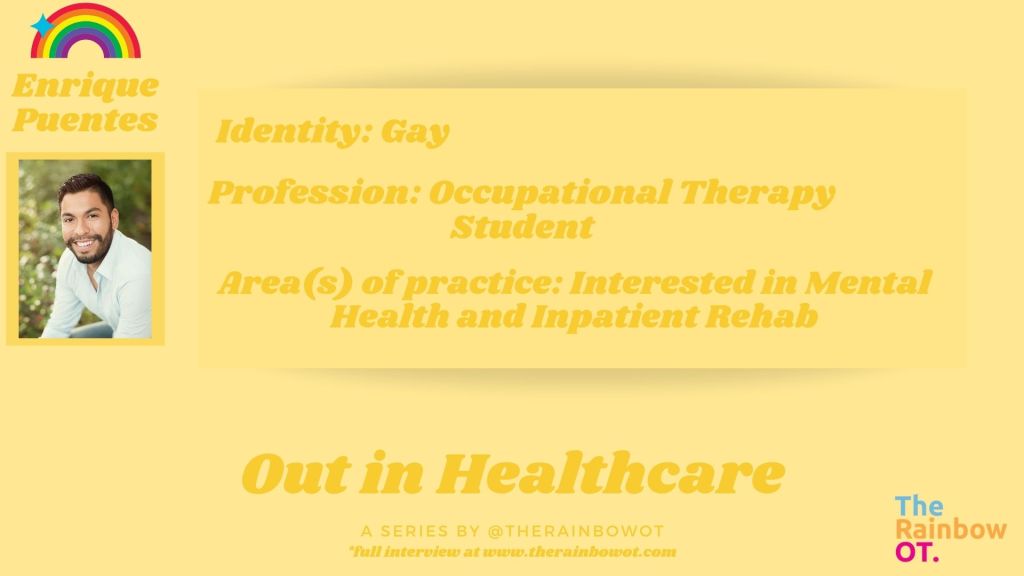
Out in Healthcare: Enrique Puentes, OTS

Name: Enrique Puentes

Pronouns: He/Him/His

Identity: Gay

Background: Both of my parents immigrated from Colombia, and I was born in Washington, D.C. I grew up in Northern Virginia but have spent the last fourteen years living in Central Florida. I have spent the past eight years working in catastrophe property insurance but have always had a longing for wanting to be in a profession that helped others improve. I finally decided to make the career transition and now am in my second term of my master’s degree.

Profession: Occupational Therapy Student (MOT)

Area(s) of Practice or Interest: I have huge interests in both Mental Health and Inpatient Rehabilitation but am unsure of where I may ultimately end up.

What does being ‘Out in Healthcare’ mean to you?: For me, being out in healthcare for me means inviting people to see my truest self. Representation of LGBT people in healthcare is important because not only does it create safe spaces for clients to feel they are being advocated for, but it also can help demystify misunderstandings that non-queer people have of the very community that I am a part of. I see being out in healthcare as a form of activism for anyone who has ever felt either marginalized in a society that has long celebrated heteronormativity.  

What is one thing everyone should know about your identity?: I want people to know that I am embracing the best possible version of myself by being out as an individual in healthcare. It is important for me to not be ‘discrete’ about my sexuality, because by me fully loving all aspects of my identity, I can in turn emanate the same level of love and care for others. 

How do you feel when your identity is included?: When my identity is included as both brown and gay, I feel included and seen as an equal amongst a group.

What does “taking up space” mean to you?: Taking up space means feeling pride about my own visibility and feeling the confidence in the fact that my visibility matters. I unfortunately did not always think/feel this way, so it’s empowering for me to live in this truth.

What is one piece of advice that you would give to healthcare workers who aren’t sure how to honor the identities of their patients?: I think with any profession that involves interacting with all kinds of people (with varying cultures, backgrounds, political and religious beliefs, sexual orientations or gender expressions), we will almost certainly at some point, come to meet someone that we lack the education on, on how to honor and respect these individuals. Maintaining a sense of humility when engaging in these interactions is key to posturing yourself in a manner that is receptive to learning from these interactions. For healthcare professions in particular, it would behoove the practitioner to educate themselves on available resources that speaks on best care practices. Remember the importance of being client-centered in your approach and advocating for the client’s desires and wishes. 

Has your identity influenced healthcare that you’ve received?: My identity has impacted the healthcare that I have received. I have encountered practicing physicians who have not been aware of pre-exposure prophylaxis medications. It’s an odd feeling having to educate your own doctor on what this is and why you are requesting a prescription for this. I have also had experiences where healthcare professionals made assumptions of my sexual orientation. I greatly see the need for education of healthcare professions in working with LGBTQ clients.

Where can people find you?: Follow me on Instagram! (@ProudOTStudent)