Categories
Blog Out in Healthcare

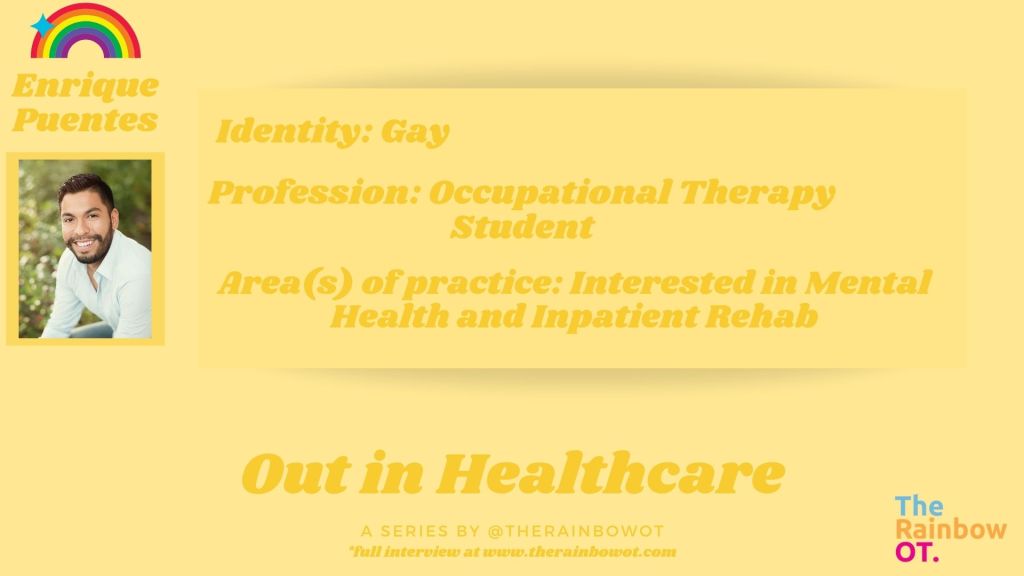
Out in Healthcare: Enrique Puentes, OTS

Name: Enrique Puentes

Pronouns: He/Him/His

Identity: Gay

Background: Both of my parents immigrated from Colombia, and I was born in Washington, D.C. I grew up in Northern Virginia but have spent the last fourteen years living in Central Florida. I have spent the past eight years working in catastrophe property insurance but have always had a longing for wanting to be in a profession that helped others improve. I finally decided to make the career transition and now am in my second term of my master’s degree.

Profession: Occupational Therapy Student (MOT)

Area(s) of Practice or Interest: I have huge interests in both Mental Health and Inpatient Rehabilitation but am unsure of where I may ultimately end up.
What does being ‘Out in Healthcare’ mean to you?: For me, being out in healthcare for me means inviting people to see my truest self. Representation of LGBT people in healthcare is important because not only does it create safe spaces for clients to feel they are being advocated for, but it also can help demystify misunderstandings that non-queer people have of the very community that I am a part of. I see being out in healthcare as a form of activism for anyone who has ever felt either marginalized in a society that has long celebrated heteronormativity.  

What is one thing everyone should know about your identity?: I want people to know that I am embracing the best possible version of myself by being out as an individual in healthcare. It is important for me to not be ‘discrete’ about my sexuality, because by me fully loving all aspects of my identity, I can in turn emanate the same level of love and care for others. 

How do you feel when your identity is included?: When my identity is included as both brown and gay, I feel included and seen as an equal amongst a group.

What does “taking up space” mean to you?: Taking up space means feeling pride about my own visibility and feeling the confidence in the fact that my visibility matters. I unfortunately did not always think/feel this way, so it’s empowering for me to live in this truth.

What is one piece of advice that you would give to healthcare workers who aren’t sure how to honor the identities of their patients?: I think with any profession that involves interacting with all kinds of people (with varying cultures, backgrounds, political and religious beliefs, sexual orientations or gender expressions), we will almost certainly at some point, come to meet someone that we lack the education on, on how to honor and respect these individuals. Maintaining a sense of humility when engaging in these interactions is key to posturing yourself in a manner that is receptive to learning from these interactions. For healthcare professions in particular, it would behoove the practitioner to educate themselves on available resources that speaks on best care practices. Remember the importance of being client-centered in your approach and advocating for the client’s desires and wishes. 

Has your identity influenced healthcare that you’ve received?: My identity has impacted the healthcare that I have received. I have encountered practicing physicians who have not been aware of pre-exposure prophylaxis medications. It’s an odd feeling having to educate your own doctor on what this is and why you are requesting a prescription for this. I have also had experiences where healthcare professionals made assumptions of my sexual orientation. I greatly see the need for education of healthcare professions in working with LGBTQ clients.

Where can people find you?: Follow me on Instagram! (@ProudOTStudent)

Categories
Blog Out in Healthcare

Out in Healthcare: Rhia Reed, OTS

Name: Rhia Reed

Pronouns: They/Them

Identity: I am a genderqueer, trans*, non-binary Korean-American with mixed heritage. I also identify as an anti-capitalist, intersectional feminist committed to the life-long work of anti-racism.

Background: My background has been primarily as a choreographer, dancer, and somatics practitioner. I am currently in school for Occupational Therapy.

Profession: Occupational Therapy

Area(s) of Practice or Interest: I’m most interested to work within the following areas of practice: mental health, neuro, palliative care, people experiencing homelessness, and currently/formerly incarcerated people.

What does being ‘Out in Healthcare’ mean to you?: Currently, I help organize a monthly zoom meeting for fellow trans/gender non-conforming (TGNC) occupational therapy students and practitioners; sign-up link below. On a more personal note, being out in healthcare means being a resource to colleagues, and one day as an advocate for my patients. I am the first trans* non-binary person that most of my classmates and professors have met, and I don’t take that lightly. I see these relationships as a huge opportunity to be a representative for the TGNC community. My hope is for my peers to feel comfortable to work through their questions and ignorance with me instead of with future TGNC patients. Once I become a clinician, I hope to create a safe space for all of my patients, especially those of trans experience. My long-term goal is to continue my work as an advocate for trans patients within the scope of occupational therapy and the greater healthcare field.

What is one thing everyone should know about your identity?: I love to laugh at myself as much as I take my identity seriously. Sometimes I joke that my gender identity is simply Tired. On other days it feels Expansive. Most days it feels Fluid.

How do you feel when your identity is included?: Whew, what a question! It is impactful to feel seen! Moments where I don’t have to direct effort to be visible or taken seriously, I feel like I can direct my energy toward all of the other things that I am passionate about. I don’t need others to validate my identity, but it’s definitely a nice surprise when the things that make me me are seen and valued. It makes me feel safer to be me.

What does “taking up space” mean to you?: First, I think of the word marginalized and what that means in a literal sense. If you’re running out of space when writing on lined paper, you end up writing in the margins. “Taking up space” means putting whatever has been relegated to the margins front and center. Pragmatically, this means reallocation of opportunities, attention, time, money, access, and resources. It’s worth mentioning that taking up space isn’t something to apologize for or feel bad about. I love to loudly celebrate members of the Queer, TGNC community.

What is one piece of advice that you would give to healthcare workers who aren’t sure how to honor the identities of their patients?: Great question! Ask questions and be patient with yourself while you are learning something new. Practice compassion and release shame. When getting things wrong, we often feel ashamed, but everyone makes mistakes. Shame bends a person’s attention inward toward their shortcomings. Instead, compassion maintains attention outward at the person they are helping. Shame is just a story we tell ourselves about ourselves to keep us small: “I messed up and I’m terrible.” Self-compassion is a different narrative: “I messed up and I’m learning. I can try again.” Compassion and mindfulness propel us to say “I messed up, and I see how my actions caused harm. I want to center that person’s experience instead of focusing on my mistake.”

Has your identity influenced healthcare that you’ve received?: Yes…I’ll keep it brief by saying that sometimes I often allow myself to be misgendered and avoid disclosing my identity out of self-preservation.

Where can people find you?: mreed9@lsuhsc.edu, and here’s the sign-up sheet for the monthly TGNC OT meeting: Click here!

Categories
Blog Out in Healthcare

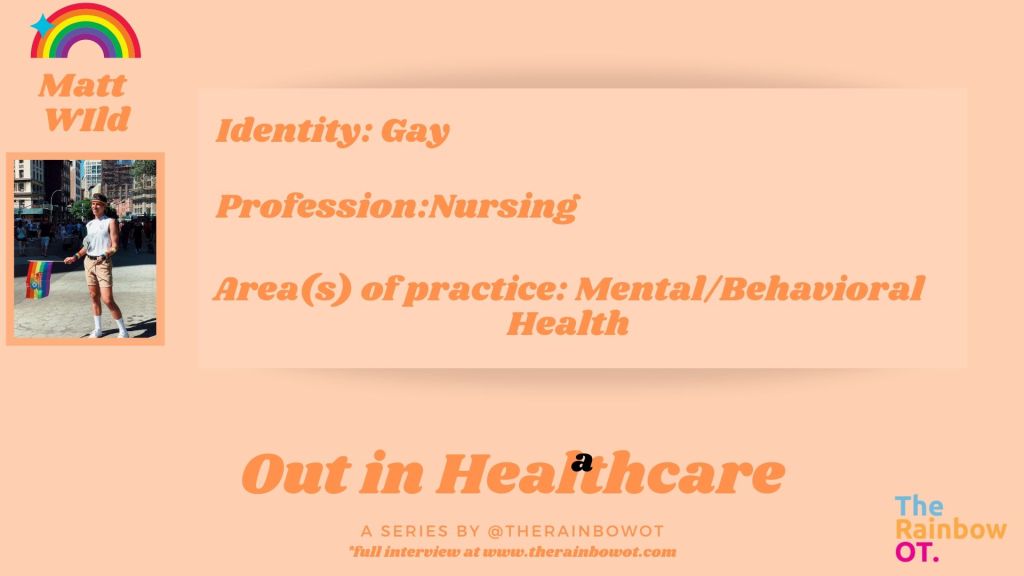
Out in Healthcare: Matt Wild BSN, RN

Name: Matthew Wild


Pronouns: He/him/his


Identity: Gay

Background: I was born and raised in Buffalo, NY. I decided to  enter nursing school because I was always inspired by the compassionate care that nurses provided me throughout my life. 

Profession: Nursing

Area(s) of practice: Mental/Behavioral Health

What does being out in healthcare mean to you?: Being out in healthcare means accepting that you are a role model to those around you. Living my truth is not always easy, but even if it eventually inspires one person to do the same, or feel represented in some way, I’m happy. 

What is one thing you think everyone should know about your specific identity or the LGBTQIA+ community as a whole?: It’s important to never make assumptions about an individual based on your stereotypes of the collective group. Each person is unique in their own way and should be treated so.

How do you feel when your identity is acknowledged and included, in the workplace/ in media OR how do you feel when your identity is not included or acknowledged?: It is amazing to see in my lifetime, the drastic changes that have already occurred in regards to LGBTQIA+ representation in the media and in workplaces. I’m hoping that the ball keeps rolling and that this can be the case for every member of the community.

What does “taking up space” mean to you?: It means living my truth and helping those around me understand better. It means showing clients who come through the clinic doors that this is a safe space, and while we may not get everything right the first time for them, they can count on the fact that we are always evolving for the better

What is one piece of advice that you would give to a healthcare professional that is unsure of how to/inexperienced with honoring and including the identity on someone within the LGBTQIA+ community while receiving healthcare services?: Accepting that you don’t have all of the answers is the first step to a therapeutic relationship with a client in the LGBTQIA+ community. Even for me, my experiences as a gay man may be completely different than those of another gay man. Understanding that a client shouldn’t have to constantly explain their existence and identity to healthcare professionals is also important.


Has your identity influenced healthcare that you’ve received in the past? Absolutely, I remember being asked on a physical if I was “safe when I was privately with girls,” or, “a guy like you must have no problem finding a nice girl.” It’s hard for some people to understand that their assumptions can be really harmful to the mental health of people in the LGBTQIA+ community, and even in some cases deter them from receiving treatment.

Where you can find Matt:

Instagram: @mjameswild